Comparison
NewsCatch vs Google Alerts
Both products watch the web for topics you name. They differ in where the results go, how much control you have over what qualifies, and whether a team or an individual is the unit of use.
Everything in the Google Alerts column below reflects Google's own public help documentation, last verified 2 August 2026.
Capability comparison
Where Google's documentation does not describe a native capability, the cell says so rather than claiming the outcome is impossible — third-party automation may cover it.
| Capability | Google Alerts | NewsCatch |
|---|---|---|
| Documented native delivery | Slack and Microsoft Teams channels | |
| Topic and keyword monitoring | Yes | Yes |
| Delivery frequency controls | Yes — as-it-happens, daily or weekly | Yes — real time or scheduled digest |
| Source, language and region options | Yes — documented sources, language, region and result-count options | Yes — you choose the exact publications and feeds monitored |
| Explicit per-article relevance score | Not documented as a native feature | Yes — visible score with an adjustable minimum threshold |
| Routing different topics to different destinations | Not documented as a native feature | Yes — one rule per keyword set and channel |
| Shared monitoring workspace for a team | Not documented as a native feature | Yes — shared projects, saved articles and channel delivery |
| De-duplication of the same story across outlets | Not documented as a native feature | Yes — near-duplicates collapsed to one canonical article |
| Quiet hours | Not documented as a native feature | Yes |
| Price | Free | Free 14-day founder-assisted pilot, then agreed commercially |
Google Alerts column describes capabilities documented in Google's public help pages. Where a capability is not described there, the cell says so rather than claiming it is impossible — third-party workflows may cover it. Last verified 2 August 2026.
The difference that matters most: destination
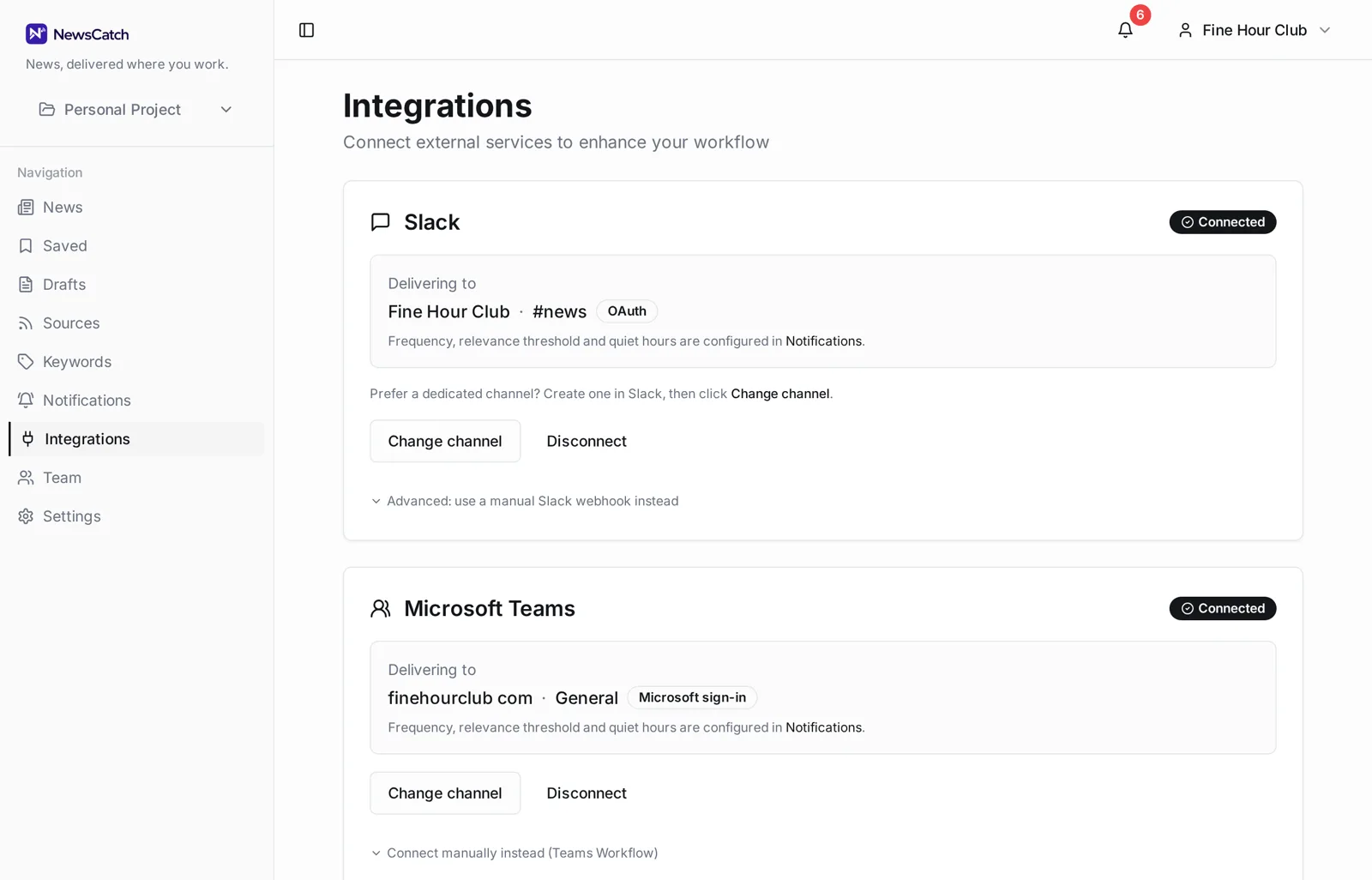
Google Alerts is documented as emailing you results. NewsCatch posts into a channel.
Email is a personal medium. One person receives the alert, and everyone else finds out when that person forwards it. In a comms team, an agency or a sales team, that single hop is where monitoring quietly stops working.
Delivering into Slack or Microsoft Teams makes coverage a shared artefact: the whole channel sees it at once and can respond in place.
The second difference: control over what qualifies
A keyword either matches or it doesn't. A score can be tuned.
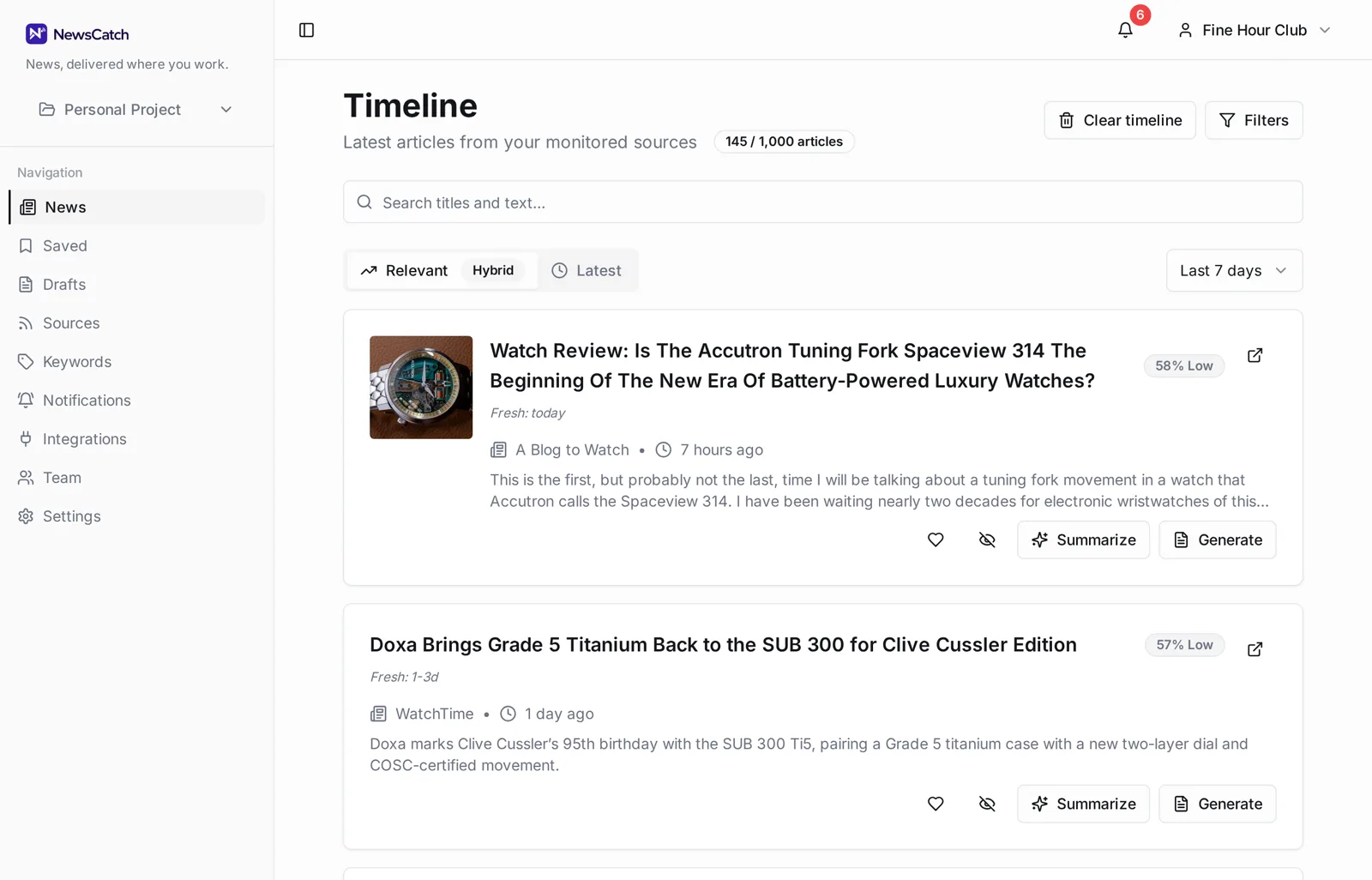
NewsCatch scores each article against your keywords and monitored topics, shows you that score, and lets each notification rule set its own minimum. When a channel gets noisy you raise the threshold instead of deleting the alert and starting again.
It also collapses near-duplicate coverage, so a story picked up by eight outlets produces one post rather than eight.
When Google Alerts is the better choice
An honest comparison has to include this.
If you are one person, watching a couple of topics, and email is genuinely where you want them, Google Alerts is free and takes a minute to set up. There is no reason to add a tool to that.
NewsCatch earns its place when several people need the same coverage, when the volume needs filtering rather than reading, or when different topics need to reach different channels.
Comparison questions
Is Google Alerts able to post to Slack or Teams?
Its documented native delivery is email. Third-party automation tools can move email into chat, so we do not claim the outcome is impossible — the distinction is that NewsCatch provides channel delivery, per-topic routing and relevance thresholds as product features.
Which one finds more coverage?
They index differently, so neither is a superset. Google Alerts draws on Google's crawl; NewsCatch monitors the specific publications and feeds you choose, which is more predictable but not automatically broader.
Can I run both during evaluation?
Yes, and it is the cleanest way to compare signal quality on your own topics. Pilots are designed to run alongside whatever you use today.
How much does NewsCatch cost compared to free?
The 14-day founder-assisted pilot is free with no card. After that we agree pricing based on how many channels and topics you run.
How current is this comparison?
The Google Alerts column was last verified against Google's public help documentation on 2 August 2026. Product documentation changes, so treat anything older than a few months as worth re-checking.
Already decided? See how the switch works in practice or start a 14-day pilot.
Related
Ready to try it? See how the 14-day pilot works.